Abstract
Cystitis is a bladder infection. In 95% of cases it is caused by Escherichia coli. Resistance to this bacterium has increased over the last decade due to the extensive use of antibiotics.
CSB Klinik is highlighting a study conducted on the rate of E. Coli resistance from March 2010 to September 2018, based on the most widely prescribed antibiotics in an ambulatory medical environment. Microbiological data was supplied by Laboratoires Réunis Luxembourg. Population: 47,030 urine samples from men and women.
Antibiotics tested: Amoxicillin, Augmentin, Ciprofloxacin, Fosfomycin, Nitrofurantoin, Trimethoprim/Sulfamethoxazole
However, the study focused solely on women as they are more affected by urinary infections than men.
Rate of resistance observed
| Antibiotics | Resistance rate |
|---|
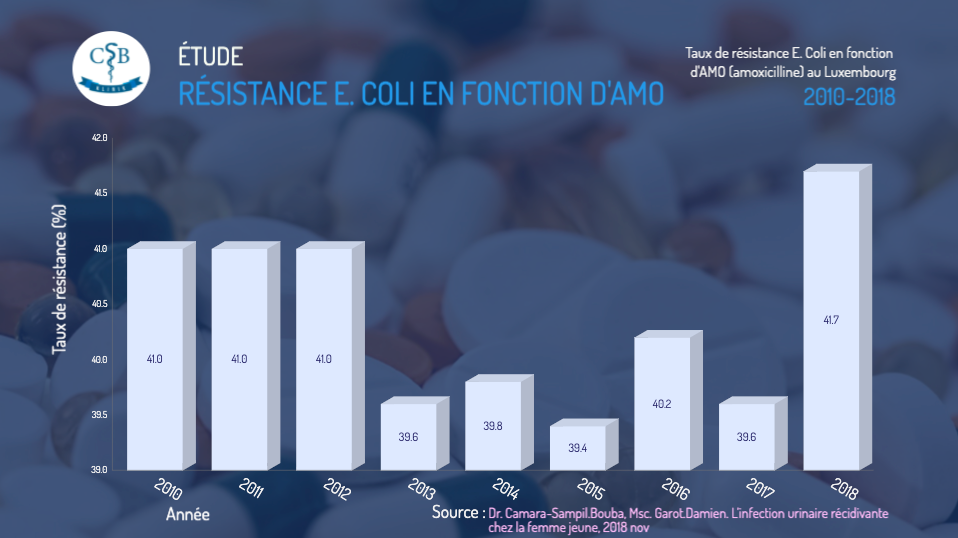
| Amoxicillin | around 41% |
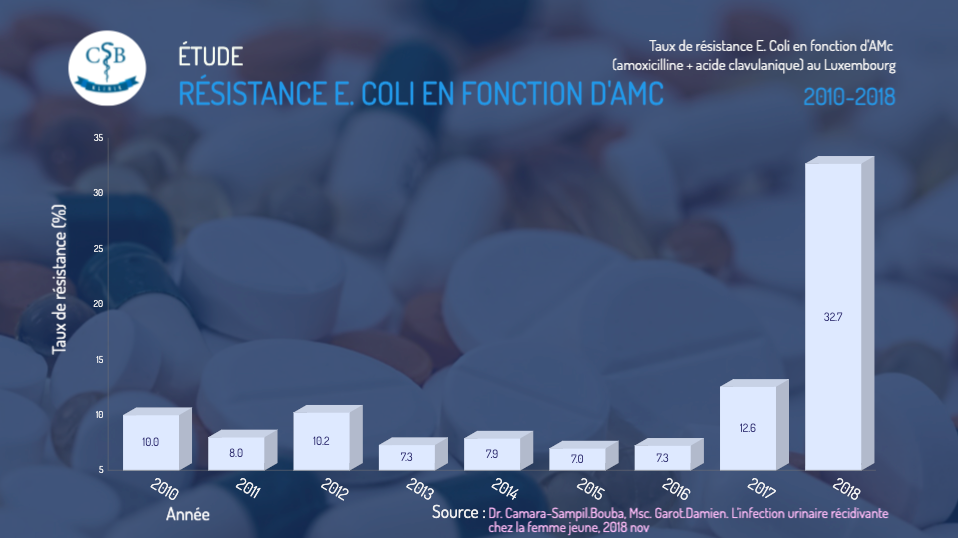
| Augmentin | around 10% between 2010 and 2017, then a sharp rise in 2018 |
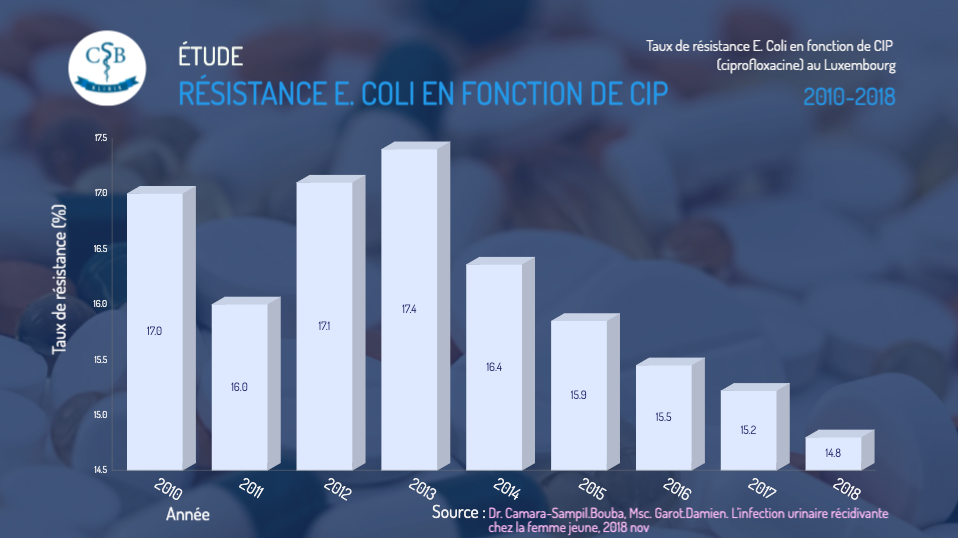
| Ciprofloxacine | around 16% |
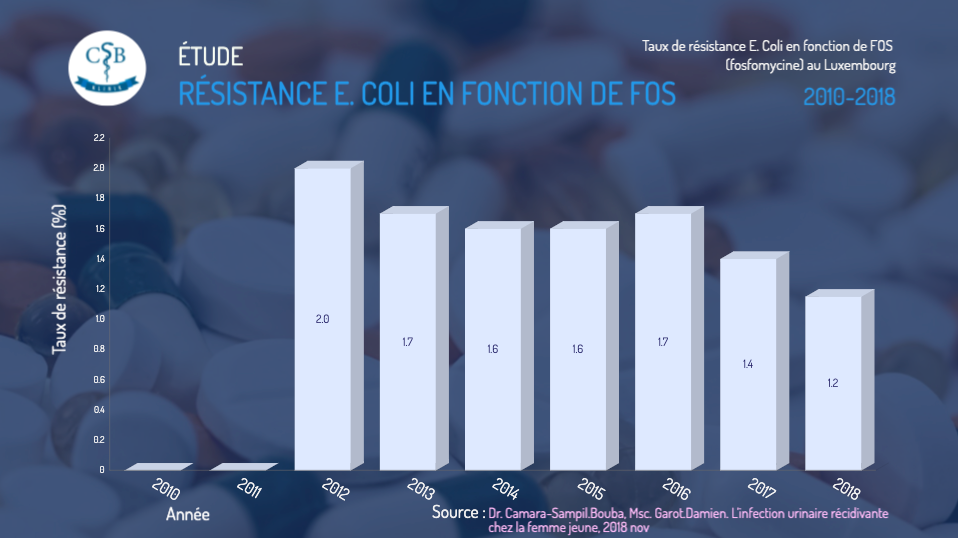
| Fosfomycine and nitrofurantoïne | each around 2% |
| Trimethoprim/Sulfamethoxazole | around 20% |
Study
CSB Klinik is highlighting a 2018 study carried out by Dr Bouba Camara-Sampil. This study evaluated E. Coli resistance over the years in the Grand Duchy of Luxembourg.
Subject
The study analysed the change in E. coli resistance rates based on the antibiotic used, from March 2010 to September 2018. It then compared the change in resistance rates between different antibiotics over time. As E. coli is responsible for around 90-95% of urinary tract infections, we will focus solely on this bacterium.
Patients and methods
This was a retrospective multi-centre study carried out at around 50 sampling sites throughout Luxembourg, processed at a large technical platform in Junglinster. Extensive antimicrobial susceptibility data from Escherichia coli isolated from urine samples was collected from March 2010 to September 2018.
Parameters
The study included data from 47,030 urine samples from men and women.
The list of antibiotics included the most commonly prescribed antibiotics with a proven efficacy used for the treatment of urinary tract infections. The antibiotics considered were as follows: amoxicillin, augmentin, ciprofloxacin, fosfomycin, nitrofurantoin, trimethoprim/sulfamethoxazole.
The study primarily focused on female urine samples, as women are the most affected by urinary tract infections.
Results
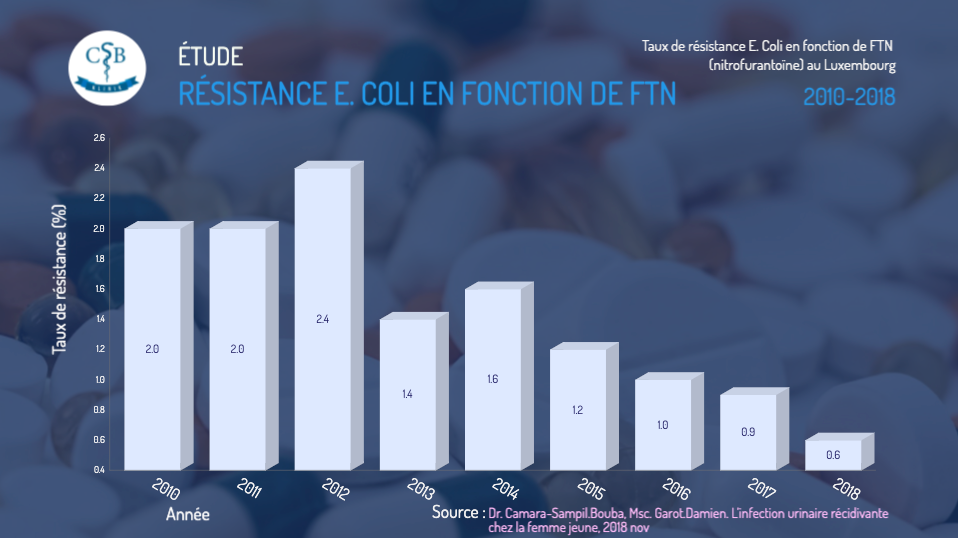
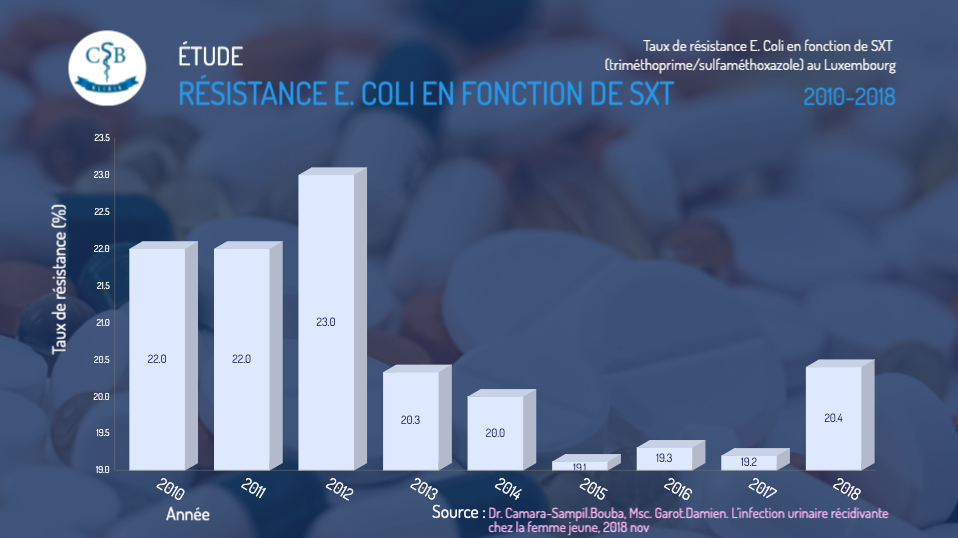
E. coli resistance rates over the years according to the antibiotic are presented below :
Discussion
| Antibiotics | Change over the period |
|---|
| AMO (Amoxicillin) | remains high at 41% in 2010 with almost no change |
| AMC (Amoxicillin + clavulanic acid) | the rate of resistance increased significantly from 10% in 2010 to 33% in September 2018 |
| CIP (Ciprofloxacin) | rate of resistance to the bacterium was already high in 2010, i.e. 17%; the rate decreased slightly 2% in 2017 but resistance remains high |
| FTN (Nitrofurantoin) | low resistance rate over the 8 years inferior 3% |
| FOS (Fosfomycin) | low resistance rate from 2010 to 2018 fluctuating between 1% and 2% |
| SXT (Trimethoprime/Sulfamethoxazole) | The rate of resistance changed very little over the eight years (around -20%) |
Limitations of the study
The number of samples increased considerably during the time of the study. Fosfomycin was not among the antibiotics tested at the start of the study and was only included from 2012 onwards
Conclusions
Both nitrofurantoin and fosfomycin have a very low rate of resistance to E. coli (around 2%) compared to the other antibiotics in this study. It is for this reason that these two antibiotics are the first choice for the treatment of cystitis. However, in his practice Dr Camara-Sampil has noticed that many patients come back to see him with symptoms after taking fosfomycin or nitrofurantoin. At CSB Klinik questions have been raised about the legitimacy of these two antibiotics for the first-line probabilistic treatment of cystitis four years after the study.
Thus CSB Klinik suggests conducting another study to evaluate changes to the rate of resistance.
Bibliography
Dr. Camara-Sampil.Bouba, Msc. Garot.Damien. L’infection urinaire récidivante chez la femme jeune, 2018 nov.
Comité de l’antibiogramme de la Société Française de Microbiologie Recommandations 2019 – V1.0 janvier 2019. In : CASFM / EUCAST : Société Française de Microbiologie Ed ; 2019: p.5-27, 30, 138-143.